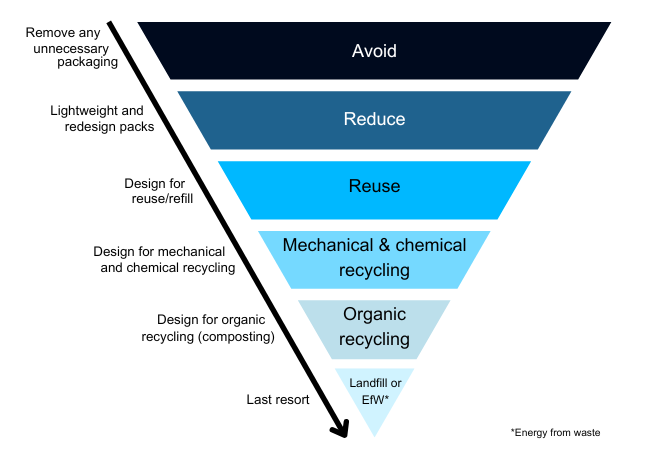
The waste hierarchy is a generally well-known concept, but can vary depending on who you’re talking to. Originally established in the European Union’s Waste Framework Directive, the waste hierarchy sets out the order of preference for the management and disposal of waste. It should be considered when designing packaging to ensure it has minimal impact on the environment.
Below is an example of how a waste hierarchy can be altered for consideration of packaging design. It’s important to work in a top-down approach, first looking at avoidance and reduction of material, then at opportunities for reuse, a recovery pathway of recycling or composting, and as a last resort, material having to go to energy-from-waste facilities or landfill.
Let’s take a deep dive into how the waste hierarchy should impact your packaging design.
The waste hierarchy sets out the order of preference for the management and disposal of waste and should be considered when designing packaging to ensure it has minimal impact on the environment. Here's what you need to know.
7 November 2024
Share
Avoid & Reduce
The most sustainable options. Can you eliminate any unnecessary material or components entirely? Sustainable packaging is that which meets the primary objective of packaging – protecting the product – while having the least environmental impact. It’s important to design out any elements of the packaging that do not serve this purpose or are excessive. This helps to reduce material use and may also help reduce litter potential.
Where possible, businesses should also look to lightweight material and design out any components or additives that may hinder the recovery of the packaging. For example, carbon black is an additive often used in plastics which impacts the ability for the plastic to be read by near infrared scanners in material recovery facilities (MRF). This means the plastic cannot be sorted into the right material or polymer stream for recovery.
By acting on ‘avoid and reduce’ you’ll improve sustainability and reduce your EPR costs at the same time.
Reuse & Refill
Once you’ve determined that the packaging is necessary, consider if it’s possible for it to be reused or refilled. When designing for reuse or refill, a full supply chain approach needs to be considered. You may design a packaging format for reuse, but does it have the necessary elements in the supply chain to be successfully reused? Consider how it will be reused – is it by the consumer in their home, or does it need to be returned to a store to be cleaned before being refilled? If it is returned to store, is the store set up to allow for the collection of materials, and is there a cleaning system in place? You can find plenty of refill and reuse inspiration in our articles here.
It's important to remember at this stage that a change to a reusable packaging format may change the way a product is designed. Ensure your product and packaging teams work together to find the right solution for your business.
When designing for reuse, consider the minimum number of reuse cycles necessary to ensure the best environmental outcomes for the packaging format when compared to its single-use alternative. Perhaps you need to use a different, heavier material type for a reusable packaging format compared to a single-use format - this may result in greater carbon emissions in transport.
Don’t forget, if you’re changing your packaging format at this stage go back to the avoid and reduce stage for the new packaging format. Whether you’ve designed the packaging for reuse or not, your next step is to determine what the end-of-life recovery pathway will be – recycling, composting or landfill.
Mechanical and Chemical Recycling
Note that recycling is midway in the waste hierarchy, but for a true circular economy, end-of-life packaging should be recycled, and the recycled materials then used to create the same packaging format. In many cases however, packaging is recycled, or “downcycled”, for used in other products.
There are two types of recycling – mechanical recycling and chemical recycling. Mechanical recycling is different to chemical recycling as it involves the sortation and physical processing of materials such as melting or grinding, compared to chemically altering the material, such as breaking polymer chains in plastics.
Recycling sits above composting in the waste hierarchy, as the materials remain at a “higher value”. The materials continue their life in the system for use (whether in the same format or for other products), whereas composting packaging loses value as it is no longer used in the packaging or product system, and instead converted to soil. Organic material is also necessary to supplement compostable packaging in composting systems.
Organic Recycling (Compost)
Organic recycling, or composting, is a mechanism through which compostable packaging can be disposed. Given organic recycling sits below mechanical and chemical recycling in the waste hierarchy, compostable packaging is less preferable than recyclable packaging, except in certain circumstances. Typically, compostable packaging is best suited to aid the recovery of food waste in closed systems – where the material is guaranteed to end up in a composting system.
It’s important to ensure you use only certified compostable packaging if choosing to go down this pathway, to ensure it has been assessed for its ability to be successfully recovered in a suitable system (whether this be home composting or industrial composting).
Energy-from-waste and landfill
If packaging cannot be designed for recycling or composting at end-of-life, it will likely end up going into a general waste bin. This is the last resort, and ultimately, as we work towards a more sustainable future and circular economy, shouldn’t be a consideration.
However, the reality is that unfortunately, for various reasons, some necessary packaging currently cannot be recovered – such as many pharmaceutical or medical product packaging formats. It is important that in these scenarios, businesses are looking to alternative materials, or designing alternative collection and recovery streams for these existing materials and formats.
Learn more about packaging sustainability
If you’d like to learn more about packaging sustainability, please read the following articles:
If you need support on your packaging sustainability journey, please reach out to our advisory team at info@ecosurety.com or ask your account manager for more information. Our friendly and knowledgeable team are happy to help!
by Alison Appleby
Packaging Sustainability Specialist
7 November, 2024
Alison is our first Packaging Sustainability Specialist. Alison has spent over eight years working in the packaging and recycling sector in Australia & the UK, engaging with government, industry bodies and brand owners.